Skolt Sámi Heritage House exhibition

The Sámi Museum also has a summer destination at the Skolt Sámi Cultural Centre in Sevettijärvi, where the Skolt Sámi Heritage House is located. The Heritage House and the Open-Air Museum on its grounds contain information on Skolt Sámi history and display the living and construction options from two different eras. There’s also a small museum shop at the Skolt Sámi Heritage House

The Skolt Sámi Heritage House comprises an authentic Koltta homestead and its outbuilding. The exhibition located inside the house tells about the life of the Skolt Sámi in the past and now. There is an Open-Air Museum on the grounds of the Heritage House. The buildings have been built on the basis of literary sources and word of mouth. The displays include homes, a storehouse, a smoke sauna and a traditional Skolt Sámi root sewn boat.

Read more on the Skolt Sámi Heritage House
See the online exhibition on the Skolt Sámi

Free admission
Summer 2025 opening hours: From June 24th until September 27th, Tue-Sat 11-17, closed on Sun and Mon.

Contact
Nuõrttsaa’mi Ä’rbbvuõttpõrtt – Skolt Sámi Heritage House
Sevettijärventie 9041, 99930 SEVETTIJÄRVI
tel. +358 (0)400 373015
email: kolttaperinnetalo(at)samimuseum.fi

Siida´s Open-Air Museum

Our Open-Air Museum has much to view. The museum area’s trail is approximately 800-metres-long and in the shape of a reindeer herder’s lasso. Along the trail visitors can view around 50 buildings and structures, which are grouped by their cultural area and their intended use. The displays tell about the cultural heritage, built heritage and livelihoods of the three Sámi cultures in Finland.

The Open-Air Museum’s trail is accessible by wheelchair and with a pram in summer and autumn. The area is protected under the Antiquities Act. To avoid erosion of the delicate surroundings, please stay on the marked, gravelled trails.

Read more about the Open-Air Museum and its exhibition or book a guided tour.

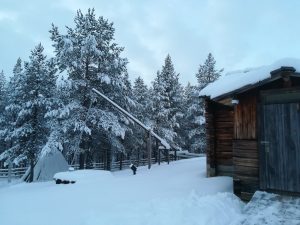
Snowy open-air museum

Opening hours

The Open-Air Museum is open according to the Sámi Museum’s opening hours and the prevailing weather conditions.

When visiting the Open-Air Museum in the winter, please take into consideration the prevailing conditions and proper clothing. You can find tips on suitable clothing for winter time on the Visit Finland website.

Mobile guide

The mobile guide provides additional information on the Open-Air Museum’s history and displays. Archive photos, videos and recordings bring the twelve Open-Air Museum displays to life. The guide is available in Northern Sámi, Finnish and English. You can access the mobile guide’s materials via QR codes found at the Open-Air Museum or have a look at the Open-Air Museum’s mobile guide here.


Main exhibition

Our main exhibition links Sámi culture and northern nature to one another forming one whole, which offers a vivid and visual experience as well as an abundance of information. The exhibition was co-produced by The Sámi Museum and Metsähallitus.

The exhibition Enâmeh láá mii párnááh – These lands are our children explains and interprets the layers of the landscape through the Sámi concept of cultural environment. According to it, nature and culture are closely linked. The landscape around us is also formed over millions of years from an entity shaped by nature.

Our exhibition was named after a poem written by Inari Sámi Matti Morottaja.

In the Sámi cultural environment, connections to the land and the environment are built through memories and traditions. The knowledge of Sámi traditions has been carried in people’s memory from one generation to another through changes in nature and society. In the cultural contents of the exhibition, we consider how the past lives in us. A diverse heritage from different eras lives in all of us, allowing us to adapt to changes around us.

In the nature section of the exhibition, we encourage our guests to reflect on changes in our climate and what will happen to the climate in the future. The exhibition highlights climate history after the last Ice Age and speculates what will happen to the climate in the future. Nature topics are discussed through the conservation areas of Northern Lapland, their different habitat types, and the species living in them.

We care for biodiversity and the cultural heritage, and our work will bear fruit across generations.

The renewal of the cultural section of the exhibition is financed by Kone Foundation, the Finnish Cultural Foundation/Museum Vision, Jenny and Antti Wihuri Foundation, Interreg Nord and Lapin Liitto. Metsähallitus received funding for the nature section of the exhibition from the supplementary state budget.

Open-Air Museum

Siida’s Open-Air Museum showcases the cultural heritage, architectural heritage and livelihoods of the Sámi in Finland

Our Open-Air Museum has much to view. The area has nearly fifty buildings and structures grouped by cultural areas and the nature of their use along an 800 metre-long trail in the shape of a reindeer herder’s lasso. The trail includes exhibits on the cultural heritage, built heritage and livelihoods of the three Sámi cultures in Finland.

The Open-Air Museum’s area is protected under the Antiquities Act. To avoid erosion of the delicate surroundings, please stay on the marked, gravelled trails. Pets are not allowed. The area is accessible by wheelchair and with a pram in summer and autumn.

Exhibits from traps and sledges to complete dwellings

Tirro Farm is the heart of the Open-Air Museum. It represents the building culture and way of life of the house-dwelling Sámi in the 1800s. Another particularly interesting exhibit is Mirhamintupa (the Myrrh Hut), a court house hut that has been moved from the border of Inari and Kittilä. It was used in court proceedings until 1905. The hut’s walls have been filled over the decades with, for example, the signatures of people waiting for their sentences. 

In addition to wood building’s the museum area contains various movable Sámi pole tents, lean-to shelters and storage structures as well as turf buildings.  The Open-Air Museum also has various types of traps, which were previously used for hunting. The Open-Air Museum’s exhibition hall has boat and sledge exhibits. 

The Open-Air Museum is also an ancient monument

The Sámi Museum’s Open-Air Museum tells of the story of Inari’s 10,000-year history.
We know that people have lived on the shore of Lake Inarijärvi at its meeting point with the River Juuanjoki as early as the Mesolithic Period of the Stone Age nearly 10,000 years ago. The area has also been inhabited numerous times during the later Stone Age as well as in the early Metal Age and the Iron Age (8,800-5,600, 1,800 and 1,400-1,200 years ago), making it a multiperiodic human dwelling area.

Excavations in the Open-Air Museum’s areas have unearthed artefacts and remains that tell of the hunter gatherer life; fire pits and the foundations of Sámi huts, as well as various tools, ceramics and the burnt bones of animals used as food.

The Open-Air Museum’s area is protected under the Antiquities Act. To avoid erosion of the surroundings, please stay on the marked and gravelled trails.

History of the Open-Air Museum

The Sámi Museum was originally established as an open-air museum in 1959. It was established by Sámii LittoSaamelaisten yhdistys ry., which was founded in 1945 as Finland’s first Sámi association.

The origin of the Sámi Museum is tied to the final part of the Second World War, the  Lapland War. As a result of the war, the majority of Lapland’s infrastructure and property was destroyed. For example, more than 90% of Inari’s buildings were destroyed. The Sámi way of life also began to change after the war as a result of which homemade daily tools slowly disappeared.  The Sámi became concerned about the changes to their material culture and the idea for establishing a museum came about.

At the  beginning, collection and recording of cultural heritage was carried out in cooperation with student clubs from the University of Turku – Varsinaissuomalainen osakunta and Pohjalainen osakunta. The connection with the university was started by Professor Paavo Kallio, Director of the Kevo Subarctic Research Institute.

The Open-Air Museum was opened in summer 1963 as the first Sámi Museum in the Nordic countries. The Sámi Museum was solely an outdoor museum opened in the summer until the completion of the Siida building in 1998. Until then, all museum pieces were also stored in the Open-Air Museum’s buildings.

The Open Air Museum, which is over six decades old, has its own museum history, which also tells about attitudes towards the museum buildings and their repairs during different eras.