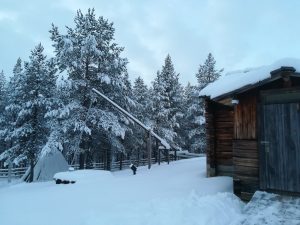
The Open-Air Museum: A Journey Through Sámi Heritage
The Siida Open-Air Museum brings to life the vibrant cultural heritage, architectural history, and traditional livelihoods of the Sámi people in Finland.
Following an 800-meter trail—shaped like a reindeer herder’s lasso—you will discover nearly fifty historic buildings and structures. These exhibits represent the three distinct Sámi cultures in Finland, showcasing their unique built heritage and way of life.
Explore Ancient Dwellings and Traditions
From intricate hunting traps and winter sledges to complete homesteads, the museum offers a deep dive into the Sámi past:
-
Tirro Farm: The heart of the museum, representing the 19th-century lifestyle of “house-dwelling” Sámi.
-
Mirhamintupa (The Myrrh Hut): A historic courthouse moved from the Inari-Kittilä border. Look closely at the walls—they are covered in signatures and inscriptions left by people awaiting their court sentences over a century ago.
-
Movable Architecture: Explore a variety of traditional structures, including transportable pole tents, lean-tos, storage sheds, and turf buildings.
-
The Exhibition Hall: Visit this indoor space to view specialized boat and sledge exhibits.
A 10,000-Year Legacy
The museum grounds are more than just a display; they are an ancient monument. Human habitation at the junction of Lake Inarijärvi and the River Juutuanjoki dates back to the Mesolithic Stone Age, nearly 10,000 years ago.
Excavations on this site have unearthed fire pits, hut foundations, ceramics, and tools. These “multiperiodic” layers of history tell the story of hunter-gatherers who thrived here through the Stone, Metal, and Iron Ages.
Our History: Protecting a Changing Culture
Founded in 1959 by Sámii Litto (Finland’s first Sámi association), Siida was born out of a need to preserve a culture under threat. Following the devastation of the Lapland War, which destroyed 90% of Inari’s buildings, the Sámi people grew concerned that their traditional tools and way of life would vanish.
With the help of students from the University of Turku, the museum opened in 1963 as the first Sámi Museum in the Nordic countries. It remained exclusively an outdoor museum until the modern Siida building was completed in 1998.
Visitor Information & Guidelines
Because the museum is located on a protected archaeological site, we ask for your help in preserving this delicate environment:
-
Stay on the Path: To prevent erosion of the ancient soil and vegetation, please remain on the marked, graveled trails.
-
Accessibility: The trail is accessible for wheelchairs and prams during the summer and autumn seasons.
-
Pets: To protect the site and local wildlife, pets are not permitted in the Open-Air Museum.
-
Preservation: The area is protected under the Antiquities Act. Please respect the structures and artifacts.