Diginatiivvat? Sámi spealut dál!

Sámi geahččanguovllut filbmaspealuin leat álgán lassánit 1980-logu rájes. Čájáhus ávvuda sámiid máhtu meroštallat ieža iežaset báikki digitála máilmmis. Dat bovde vásihit, mot árbevierut, dálááigi ja boahtteáiggit deaivvadit digitála máilmmiin. Čájáhus buktá bálddalagaid sámi speallanovdáneami iešguđetlágan hámiid. Čájáhusa lávdespealut čujuhit duddjoma lágan bargamii ja speallankultuvrra guhkit árbevieruide: dat leat konkrehtalaččat, dávvirat maid sáhttá guoskat gieđaiguin ja maid guovddážis leat duddjoma luottat ja ávdnasat. Dan bálddas oaidnit sihke báikkálaš, searvvušlaš ja viiddit gávppálaš buvttademiid ja digitála duojárvuođa, dego riikkaidgaskasaš fuomášumi ožžon Skábma – Snowfall ja Raanaa The Shaman Girl, mat ovddastit sámi spealuid ovdáneami dálá áiggi.

Čájáhusa spealut leat hábmejuvvon sámi geahččanguovlluid vuođul, ja dat buktet ovdan sámi doaibmivuođa digitála kultuvrras. Spealut hábmejit iežaset, ieža meroštallon digitála mieldeorruma ja ávkkástallet fikšuvnna ja spekulatiivvalaš boahtteáiggiid ja rahpet saji miellagovahallamii, molssaeavttuide ja muitaleami ođđa vugiide. Seammás dat dahket oinnolažžan, ahte árbevirolaš sámi máidnasat ja figuvrrat leat sámiid kollektiivvalaš vuoiŋŋalaš opmodat – servoša ealli árbevierru, mas álo ođđasit ráđđádallojuvvo.

Bajásgeassindiehtagiid magisttar, Outi Kaarina Laiti, lea sápmelaš speallodutki ja -plánejeaddji Helssega universitehtas. Su bargu gullá bajásgeassindiehtagiid, dieđuidgieđahallama ja sámekultuvrra gaskii. Laiti ovddida sámiid searvvušlaš spealloovdáneami ja lea okta Saami Game Jam -dáhpáhusa vuođđudeddjiin.

Dát čájáhus lea ollašuhttojuvvon Koneen säätiö Biokultuvrralaš árbi ja ii-lineára áigi -fitnu doarjagiin.
Digital Natives? Saami Games Now!

Sámi perspectives in video games have become increasingly common since the 1980s. This exhibition celebrates the ability of the Sámi people to define their own place in the digital world. It invites visitors to experience how traditions, the present, and various futures converge in digital realms.

The exhibition brings together diverse manifestations of Sámi game development. The board games on display refer to craftsmanship and the longer traditions of gaming culture: they are concrete, tactile objects where the mark of the maker and materiality are at the core. Alongside them are local, communal, and broader commercial productions, as well as digital craftsmanship. This includes internationally acclaimed titles such as Skábma – Snowfall and Raanaa – The Shaman Girl, which represent the present day of Sámi game development.

The games featured have been created from Sámi starting points, highlighting Sámi agency in digital culture. By utilizing fiction and speculative futures, these games build a self-defined digital presence and open up space for imagination, alternatives, and new ways of storytelling. At the same time, they make it visible that traditional Sámi stories and characters are the collective intellectual property of the Sámi – a living heritage shared by the community and constantly renegotiated.

Dr. Outi Kaarina Laiti is a Sámi game researcher and designer at the University of Helsinki. Her work focuses on the intersections of education, computer science, and Sámi culture in video games and programming. Laiti promotes communal game development among the Sámi: between 2014 and 2023, more than a hundred game makers have produced over 40 games in the Utsjoki region and on digital platforms.

This exhibition has been realized with the support of the Kone Foundation’s project Biocultural Heritage and Non-linear Time.

The Unregulated Old-Growth Forests of Sápmi – A Photography Exhibition on Endangered Forests

In Finnish Sápmi, there are over 3,000 km² of old natural forests that have no legal protection. These forests are at risk of disappearing due to forestry, construction, and other intensive land use. The Natural Forests Sápmi research group is mapping these unique old-growth forests that remain unprotected.

The old forests of Sápmi form part of an exceptional remaining belt of natural forests on a European scale, stretching across the northern regions of Finland as well as Norway, Sweden, and Russia. Each photograph in the exhibition captures a moment from this rare, living whole.

Old-growth forests are vital for endangered species that depend on ancient woodland, but their importance goes far beyond this. They are the foundation of Sámi culture and especially Sámi reindeer herding. Free-ranging reindeer husbandry relies in winter on lichens—such as ground lichens, beard lichens, and tree lichens—found in old forests, food sources that are scarce in managed commercial forests.

The permanent protection of these legally unprotected forests is crucial for Finland to fulfill its obligations to safeguard Sámi culture and preserve biodiversity. This exhibition invites viewers to see and reflect on what can still be saved.

The Natural Forests Sápmi research group includes Inari-born researcher and Doctor of Engineering Jan Saijets, long-time forest mapper and nature photographer Juha Länsman from Inari, and experienced forest inventory specialists Jarmo Pyykkö and Olli Manninen. Everyone’s photos are on display at the exhibition.

The exhibition has been supported by the Kone Foundation.

Duodjebálgát

In the exhibition, we travel alongside two Saami artisans to explore the Saami craft traditions and skills passed down through their families. We also delve into the formation of the artisans’ own craft identities. 

Duodjebálgát is Reetta and Birit’s first joint exhibition. While Birit has until recent times focused more on creating traditional duodji, Reetta has taken steps toward contemporary Sámi fashion design. For this exhibition.

The exhibition opens in November, with the exact date to be announced later. It will be on display at the Sámi Museum Siida until 15 March 2026.

Polar Lights

Rayann Elzein is a French nature photographer and polar expedition leader based in Utsjoki, the northernmost municipality of the Finnish Sapmi. His work is deeply rooted in the Arctic landscapes that surround him daily — silent forests, frozen rivers, reindeer trails, and the shifting skies of the Northern Lights. Through his photography, Rayann captures both the delicate stillness and raw energy of Sapmi´s seasons, always with respect for the land and the life it holds.

With years of experience guiding and photographing in Svalbard and Antarctica, Rayann also brings to this exhibition a glimpse of the southern polar world. As a bonus to the core focus on Sapmi, Polar Lights includes selected images from Svalbard and Antarctica—icy coastlines, dramatic wildlife, and fleeting moments of southern light—offering a visual dialogue between the North and the South.

Rayann’s work is guided by a deep respect for nature, a commitment to conservation, and a passion for sharing the fragile beauty of the polar regions with others.

The “Polar Lights” exhibition is organized by Metsähallitus´s Northern Lapland Nature Centre, Siida

Beneath the lake bed

Geahčan botniid duohkái – Beneath the lake bed – an exhibition where Sámi handicrafts, duodji, are intertwined with art and poetry. Sámi artists Jouni S. Laiti and Kirsi Máret Paltto combine traditional materials – cardboard, reindeer horn and wool – with industrial materials to create works that bring together past and present.

The themes of the exhibition come from the environment, love and spirituality. The poems function as part of the works, deepening their message.

Jouni S. Laiti is a Sámi artist and duodji teacher from Mierasjärvi, currently living in Inari. Kirsi Máret Paltto is a Sámi artist and writer. She is originally from Fierranjoki, in the Tenojoki valley, but has lived for many years in Karasjoki and abroad.

The exhibition is on display in Siida from 22.5.2025 to 30.10.2025 and is produced by the Sámi Museum Siida.

The exhibition is supported by the The Finnish Heritage Agency.


In the Time of Aihki

“In the Time of Aihki (The Old-Growth Pine)” exhibition was born from Anna Pakkanen’s personal experience during a skiing trip in Urho Kekkonen National Park, where she discovered an impressive forest full of old pines. The experience made her reflect on the long lifespan of trees and the shortness of human life. The exhibition offers visitors an opportunity to stop and contemplate the relationship between nature and time.

“Pakkanen wanted to highlight the stories of the trees and their significance for biodiversity. The exhibition combines information gathered from old forest experts as well as her own thoughts and experiences, which have been transformed into visual works.

Inspired by the old pines of Urho Kekkonen National Park and their long lifespans, Pakkanen developed an exhibition that tells the stories of these old-growth pines. “In the Time of Aihki” exhibition mainly features paintings, but also small wooden sculptures.

Anna Pakkanen’s work “Tree of Eternity.”

– I began to think about those pines and how insignificantly short human life is compared to the life of trees. The life of an old-growth pine pine, from seed to becoming a fully decomposed tree trunk, can last 800 years. A tree now decomposing began to sprout around year 1200″, Anna Pakkanen describes her thoughts and observations during the skiing trip.

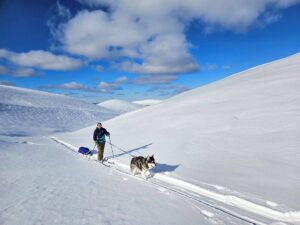
Hiihtäjä puuttomassa tunturissa, ahkio perrässään ja koira valjaissa.
Anna Pakkanen was inspired by the old-growth pines she saw during her skiing trip.

Anna Pakkanen holds a Master of Arts degree, is a graphic designer, and an illustrator who works for Metsähallitus, Parks & Wildlife Finland. The nature storybook “Kuura and Pyry, which was published in autumn 2024, depicts the arrival of winter in a northern forest, and it was illustrated by Anna Pakkanen.

The “In the Time of Aihki” exhibition is organized by Northern Lapland Nature Center, Siida.


Kaamosmaisemia – Skábmaduovdagat

Kaamosmaisemia – Skábmaduovdagat (Landscapes of the Polar Night) is an exhibition composed of sceneries of sound and movement and born from the emotional landscapes of the Polar Night. It is made of artistic short films in which the period of darkness is described in terms of subjective experiences. 

The working group reflects on darkness as interior and exterior phenomena that impact on each other. In addition, they also look at the cyclic nature of the phenomenon. Many people who live in the north do not experience this season as dark, though the polar night is often described as such. The exhibition offers the viewers an opportunity to experience the polar night with its changes and shades through the artistic landscapes created by artists living in Inari.

The working group consists of Janita Rantanen, Sunna Nousuniemi (Radio-Juhani Sunná Máret), Sakari Maliniemi, Tomi Lampinen and Nicholas Francett.

The exhibition has been produced by the Sámi Museum Siida and the artists have been granted support for their work by Kone Foundation, Arts Promotion Centre Finland (Taike), Municipality of Inari and International Sámi Film Institute.

Kaamosmaisemia – Skábmaduovdagat is open at Siida until March 23, 2025. Siida is open in the winter season from Monday to Saturday from 10 a.m. to 5 p.m., and in the summer season (1.6.–30.9.2024) every day from 9 a.m. to 6 p.m. On public holidays, the opening hours may be different, so check them at www.siida.fi.

Ánnámáret & Marja Viitahuhta: Bálvvosbáiki

Bálvvosbáiki (worship site) is an exhibition composed of video works and based on the yoiks of the musician Ánnámáret. The works have been created in cooperation by Ánnámáret, the media artist Marja Viitahuhta and musicians Ilkka Heinonen (bowed lyre jouhikko) and Turkka Inkilä (elektronic music).

The works reflect on how the Sámi world-view is manifested in our time. According to this world-view, humans are part of their environment – not owners but users of the environment who take into consideration the legacy of the past generations and foster the conditions for life for the future generations. The land, the plants, the animals and humanity form together a whole the elements of which depend on each other.

To represent Sápmi, the Land of the Sámi, the artists use experimental and searching techniques in their works. The image and the sound enter a dialogue with each other, forming mutual horizons and meanings of interpretation and creating space for and accompanying each other.

The exhibition, produced by the Sámi Museum Siida, is open at Siida until September 29, 2024.

The exhibition is supported by the Finnish Heritage Agency.

Northern Taiga – Land of Willow Grouse and Rock Ptarmigan

Exhibition, “Northern Taiga − Land of Willow Grouse and Rock Ptarmigan”, shows survivors, Willow Grouse and Rock Ptarmigan, which have perfectly adapted to the northern taiga over the times, in their own habitats.

The exhibition shows survivors, Willow Grouse and Rock Ptarmigan, which have perfectly adapted to the arctic taiga over the times, in their own habitats.

Found in winter on the top of extreme cold and snow-covered fells, where only few animals thrive, Rock Ptarmigan is an example of a real survivor searching something to eat. Willow Grouse, better adapted to lower terrains and valleys of thick snow, finds buds and twigs more easily. Both birds blend with their pure white winter plumage to the snow so perfectly that finding them to take photographs requires sometimes a long-lasting search without any guarantee of  success.

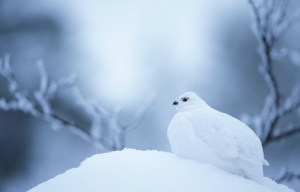
Valkoinen riekko lumikummun päällä siniharmaata taustaa vasten.

Night less summer nights, a period when the sun doesn’t set at all in arctic, provide for a photographer a wonderful possibility to take beautiful, orange-colored pictures through the whole night. After changing their summer plumage birds may sometimes disappear completely into the colors of the environment while resting, so the photographer must be careful when searching the birds and to avoid any disturbance.

Global warming is already bringing challenges to both species as the snowy season shortens, and the color of their plumage is not necessarily optimal. Challenges are also caused when the predators like red fox spread higher to the fells.

The photos of the exhibition were taken in municipality of Inari and Sodankylä in the coldest conditions of winter and close to midnight in night less summer night.

Sami Vartiainen is a photographer specialized in bird photography and based in Helsinki, Finland. His area of photographing covers both Finland and northern Norway. His favourite seasons are midwinter as well as night less nights in midsummer in arctic Lapland.